
Electrochemical Upcycling of Plastic Waste: A Systematic Review of Catalyst Development, Reactor Engineering and Scale-Up Pathways
-
Ifeoma Martha Ogbodo
Department of Chemical Engineering, Faculty of Infrastructure, Processing and Engineering Technology, Federal University of Technology Minna, Niger, Nigeria
David Chinonso Anih

Department of Biochemistry, Faculty of Biosciences, Federal University Wukari, Taraba, Nigeria
Cherish Onyedikachi ChukwuDepartment of Petroleum Engineering, School of Engineering, Federal University of Technology, Owerri, Nigeria
Mustapha Olanrewaju KotunDepartment of Civil Engineering, School of Engineering, Yaba College of Technology, Lagos, Nigeria
Nwanze Tobechukwu JosephDepartment of Civil and Environmental Engineering, University of Lagos, Akoka, Lagos, Nigeria
Usman Garba SharifaiDepartment of Chemistry, Faculty of Physical Sciences, Bayero University Kano, Kano, Nigeria
| Received 24 Mar, 2026 |
Accepted 09 Jul, 2026 |
Published 15 Jul, 2026 |
This systematic review examines the emerging field of electrochemical upcycling as a route for converting plastic waste into value added chemicals, fuels, and polymer derived intermediates. The review draws on recent experimental and demonstration studies reported from 2021 through 2025, with emphasis on systems that provide quantitative electrochemical performance data, reactor information, and technoeconomic or life cycle evidence. Across the literature, electrochemical upcycling is shown to offer a flexible platform for transforming major waste plastics, particularly polyethylene terephthalate, polyethylene, polypropylene, polystyrene, and mixed plastic streams, through anodic oxidative cleavage, cathodic reductive fragmentation, mediated electrolysis, electroreforming, and paired electrolysis. The manuscript synthesizes current knowledge on catalyst design, mechanistic control, reactor engineering, product selectivity, and scale up readiness. Reported electrocatalysts include noble metals, transition metal oxides and hydroxides, metal phosphide derived oxyhydroxides, doped carbons, single atom catalysts, and molecular mediators, each contributing different advantages in activity, selectivity, and durability. The review also highlights the growing importance of microenvironment control, adsorption tuning, and in situ surface reconstruction in improving catalytic performance. Reactor development has advanced from batch H cells to continuous flow systems, membrane electrode assemblies, zero gap cells, and gas diffusion electrodes, enabling higher current densities, improved mass transfer, and better integration with downstream separations. Performance trends indicate that polyethylene terephthalate-derived feeds are currently the most tractable, with several systems achieving high Faradaic efficiencies and industrially relevant current densities under alkaline flow conditions. In contrast, the electroconversion of polyolefins remains less mature and often requires multistep or hybrid catalytic strategies. Despite encouraging progress, major barriers remain, including feedstock heterogeneity, catalyst degradation, salt management, separation energy, and inconsistent reporting standards. The review concludes that meaningful scale up will depend on standardized test feeds, harmonized performance metrics, integrated pilot demonstrations, co designed separation technologies, and policy support that can accelerate early markets for circular chemicals and fuels.
| Copyright © 2026 Ogbodo et al. This is an open-access article distributed under the Creative Commons Attribution License, which permits unrestricted use, distribution, and reproduction in any medium, provided the original work is properly cited. |
INTRODUCTION
Plastic pollution has become a defining environmental challenge of the 21st century. Annual global plastic production now reaches hundreds of millions of tonnes while recovery and reprocessing rates remain far below the level required for a truly circular economy. Mechanical recycling, the most widely deployed route, preserves polymer mass but suffers from progressive material degradation, sensitivity to contamination, and limited compatibility across polymer types. These technical and lifecycle limitations constrain mechanical recycling from closing material loops at scale and have motivated the expansion of research into chemical strategies that restore polymers to monomers or convert waste into higher-value chemicals and fuels, thereby improving resource efficiency and circularity1.
Among chemical approaches, electrochemical upcycling has emerged as a flexible pathway that couples electricity, increasingly sourced from renewables, with surface catalysis to selectively break bonds, functionalize fragments, or reform polymer-derived streams into commodity chemicals, platform molecules, or fuels. Compared with thermal cracking and some catalytic hydroprocesses, electrochemical methods can operate under mild conditions, exploit paired anodic and cathodic reactions for improved energy efficiency, and enable precise control over redox state and selectivity through applied potential, current density, and reactor configuration2.
To reduce ambiguity, clear definitions was adopted. Mechanical recycling refers to physical reprocessing that preserves polymer chains, such as reextrusion and remelting. Chemical recycling denotes processes that chemically transform polymeric chains, including depolymerization, pyrolysis, and solvolysis. Electrochemical upcycling denotes electrochemically driven transformations that convert waste polymers or their hydrolysates into higher value chemicals, fuels, or monomers via electron transfer catalysis at electrodes or within electrochemical reactors. Electrochemical upcycling can be applied either to depolymerize polymers or to upgrade depolymerization products through electro oxidation and electro reforming. It often capitalizes on paired reactions, for example value product generation at both anode and cathode, to improve overall process economics and energy efficiency3,4.
Recent demonstrations range from electrocatalytic PET upcycling to paired formate and hydrogen production and potential cycling strategies that extend catalyst lifetime. These studies illustrate both the promise and the practical challenges of moving electrochemical upcycling toward commercial impact5,6.
Key questions addressed in the review include which catalysts and interfaces enable selective bond cleavage or oxygenate production from polymer hydrolysates, which reactor formats best balance productivity, separation and scale economics, how feed heterogeneity and mixed wastes influence process design and downstream purification, and what techno-economic bottlenecks and lifecycle considerations must be solved to ensure genuine environmental benefit when electricity separation and capital costs are accounted for. By mapping recent advances against these questions, this work provides a practical and up-to-date foundation for advancing electrochemical routes from laboratory-scale research to sustainable industrial application7.
This review focuses on the electrochemical upcycling of principal commodity polymers that dominate municipal and industrial waste streams: Polyethylene terephthalate PET, polyethylene PE, polypropylene PP, polystyrene PS, polyvinyl chloride PVC, and realistic mixed streams. This study examines catalyst design principles for bond activation and selectivity, reactor concepts and scale-adaptable cell architectures such as flow cells and membrane electrolyzers, representative product portfolios including monomers, oxygenates, formate and glycolate, aromatics, syngas derivatives, and hydrogen co-production, techno economic and scale-up pathways that connect laboratory demonstrations to industrial viability.
MATERIALS AND METHODS
This review synthesizes the rapidly expanding body of literature on the electrochemical upcycling of plastic waste into value-added chemicals and fuels. The search and selection methodology is outlined, followed by a description of the classification framework used to organize reaction pathways and feedstock types. In addition, the survey approach for catalytic materials and their mechanistic interpretation is presented. The reactor designs and process configurations examined in the literature are also discussed, alongside the performance indicators, techno-economic considerations, and analytical metrics employed to evaluate advancements in the field.
LITERATURE SEARCH AND SELECTION CRITERIA
Search strategy: A structured and reproducible literature search was conducted to identify studies on the electrochemical upcycling of plastic waste into value-added chemicals and fuels. The search was carried out across major scholarly databases, including Web of Science, Scopus, PubMed/PMC, ACS Publications, Wiley Online Library, and ScienceDirect, and was supplemented by Google Scholar screening to capture relevant studies that may not have been indexed consistently across all databases. In addition, the reference lists of eligible articles and recent review papers were manually searched to identify further relevant publications8.
The search strategy combined controlled vocabulary and free-text terms using Boolean operators. Core keywords included “electrochemical upcycling”, “electrocatalytic upcycling”, “electroreforming”, “electrooxidation”, “paired electrolysis”, “flow electrolysis”, “plastic waste”, “PET”, “polyethylene”, “polypropylene”, “polystyrene”, “PVC”, “reactor”, “membrane electrode assembly”, “techno-economic analysis”, and “life cycle assessment”. Search strings were adapted to the syntax of each database to maximize sensitivity and relevance. The search was limited to English-language publications published between 2021 and 2025 to ensure that the review reflected contemporary developments in catalyst design, reactor engineering, process performance, and scale-up pathways. This approach was consistent with the manuscript’s emphasis on catalyst development, reactor concepts, process performance, and techno-economic considerations in electrochemical plastic upcycling9,10.
Inclusion criteria
Studies were eligible for inclusion if they met all of the following criteria:
| • | They were peer-reviewed journal articles or review papers | |
| • | They focused on the electrochemical conversion, upcycling, reforming, or electro-oxidative upgrading of plastic waste or plastic-derived intermediates | |
| • | They addressed at least one of the following: Catalyst development, reactor configuration, process performance, mechanistic interpretation, techno-economic analysis, or life cycle assessment | |
| • | They reported sufficient experimental or analytical detail to allow meaningful interpretation of the electrochemical process | |
| • | They were published in English within the defined time window of 2021 to 2025 |
For the purposes of this review, studies that directly informed the core synthesis were included in the main review, while closely related papers that provided methodological, mechanistic, reactor engineering, or techno-economic context were retained as background references.
Exclusion criteria
Studies were excluded if they met any of the following conditions:
| (i) | They were duplicates or redundant reports of the same work | |
| (ii) | They were conference abstracts, editorials, commentaries, opinion pieces, or non-peer-reviewed reports | |
| (iii) | They dealt exclusively with mechanical recycling, thermal recycling, pyrolysis, or biological recycling without an electrochemical component | |
| (iv) | They did not address plastic waste, plastic-derived feedstocks, or polymer-upcycling systems | |
| (v) | They lacked quantitative performance data, clear electrochemical methodology, or sufficient analytical detail | |
| (vi) | The full text was unavailable, or the article was not written in English |
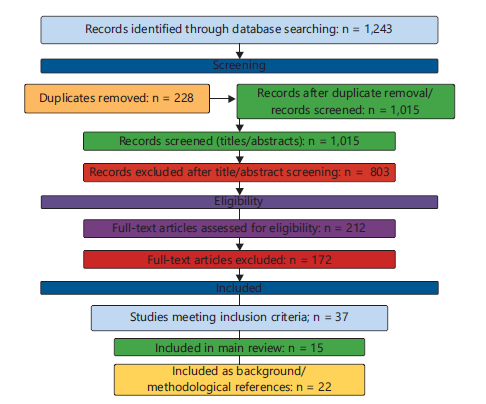
Study selection: Records were identified through database searching across Web of Science, Scopus, PubMed/PMC, ACS Publications, Wiley Online Library, ScienceDirect, and supplementary Google Scholar screening. A total of 1,243 records were retrieved. After removal of 228 duplicates, 1,015 unique records remained for title and abstract screening. Of these, 803 records were excluded because they were not relevant to the electrochemical upcycling of plastic waste or did not meet the review’s eligibility criteria9,10.
A total of 212 full-text articles were assessed for eligibility. After full-text review, 172 articles were excluded for one or more of the following reasons: they were not focused on electrochemical upcycling of plastic waste into chemicals or fuels; they lacked quantitative electrochemical performance data or detailed reactor, catalyst, or techno-economic information; they were commentaries, opinions, editorials, or other unsuitable study designs; they contained insufficient or irrelevant data to address the review question; they were not available in English; or they were duplicate reports or preliminary abstracts.
Overall, 37 studies met the inclusion criteria. Of these, 15 studies were included in the main review. In comparison, 22 studies were retained as background or methodological references to support the discussion of catalyst development, reactor concepts, process performance, and techno-economic and scale-up pathways. The selection process followed a transparent screening workflow consistent with PRISMA-style reporting for systematic reviews8-10.
Common reasons for full-text exclusion:
| (i) | Not focused on the electrochemical upcycling of plastic waste into value-added chemicals or fuels | |
| (ii) | Lacked quantitative electrochemical data, catalyst details, reactor information, or TEA/LCA evidence | |
| (iii) | Wrong study design, such as commentary, opinion piece, or editorial | |
| (iv) | Insufficient or irrelevant data to answer the inclusion criteria | |
| (v) | Not in English or full text not available | |
| (vi) | Duplicate reports or preliminary abstracts |
Figure 1 presents the PRISMA flow diagram summarizing the literature search, screening, eligibility assessment, and final study inclusion process described in Literature Search and Selection Criteria.
Classification framework used in the review: To structure diverse experimental approaches, a multi-axis classification framework was adopted: reaction type, target products, feedstock type and pre-treatment requirements. This framework helps compare strategies on the basis of reaction chemistry, product value, process complexity and scale-up readiness. Emphasis was on the concept of paired electrolysis rational co-optimization of anodic and cathodic chemistries to improve overall energy and economic efficiency which increasingly frames modern upcycling approaches11.
Reaction types: Electrochemical transformations was grouped into a small set of mechanistic classes that recur in the literature: (i) Anodic oxidative cleavage/oxidation of polyol fragments (e.g., ethylene glycol from PET hydrolysate) to carboxylates or diacids; (ii) Cathodic hydrogenolysis or reductive fragmentation of carbon backbone fragments; (iii) Paired electrolysis schemes where anodic oxidation of biomass or waste organics replaces oxygen evolution, thereby lowering cell voltage and co-producing valuable anode products; (iv) Mediated or indirect electrolysis where redox mediators shuttle electrons to drive homogeneous catalysis; and (v) Electroreforming where combined anodic oxidation and cathodic hydrogen evolution convert polymer derivatives into H2 plus commodity small organics11.
|
| Table 1: | Polymer feedstock categories, typical contaminants/additives, and handling pre-treatment methods | |||
| Feedstock category | Typical contaminants/additives | Typical pretreatment | Citation(s) |
| Clean single polymer (PET bottles) |
Labels, adhesives, and residual food | Mechanical shredding, alkaline hydrolysis to EG+TPA |
Zhai et al.11, Lee et al.12 |
| Mixed household streams (PE, PP, PET) Composite materials (multilayer packaging,textiles) |
Dyes, plasticizers, fillers, adhesives Metallized layers, adhesives, pigment packages |
Sorting, solvent fractionation, catalytic solvolysis Chemical delamination,pyrolytic pretreatment, and enzymatic hydrolysis |
and Du et al.13 |
| This table compares clean single polymer streams, mixed household plastics, and composite materials based on their practical handling needs. It highlights the kinds of contaminants that can affect conversion efficiency and product quality. PET: Polyethylene terephthalate, PE: Polyethylene, PP: Polypropylene, PVC: Polyvinyl chloride, EG: Ethylene glycol and TPA: Terephthalic acid | |||
Target products: A pragmatic taxonomy separates commodity monomers (terephthalic acid, ethylene glycol derivatives), platform chemicals and fuels (formate, glycolate, CO, syngas, H2), and carbon materials (carbonaceous solids, graphitic carbon). Product value and market size influence process design decisions; for example, producing glycolic acid (as a monomer for polyglycolic acid) can be highly valuable when separation and polymerization steps are considered12.
Feedstock categories and pretreatment: Feedstocks are classified as: (a) Clean single-polymer streams (e.g., bottle-grade PET), (b) Mixed post-consumer streams (mixtures of PET, PE, PP with additives and dyes), and (c) Contaminated or composite materials (textiles, multilayer packaging). Pretreatment ranges from simple size reduction and alkaline hydrolysis for PET to chemical depolymerization or solvent-assisted extraction. The literature shows that PET is currently the most tractable feedstock for electrochemical pcycling because hydrolysis yields soluble ethylene glycol that can be directly oxidized at the anode13.
Table 1 shows the main plastic feedstock groups, the impurities they commonly carry, and the pretreatment steps usually needed before electrochemical processing.
| Table 2: | Electrocatalyst classes, typical synthesis methods, and key properties reported | |||
| Catalyst class | Typical synthesis approach | Key reported properties | Citation(s) |
| Noble metal alloys (Pd, Pt, PdCu) |
Wet chemical deposition, electrodeposition | Low overpotential, high FE; cost and scarcity concerns |
Shi et al.14, Anih et al.15 |
| Non-noble transition metal oxides/hydroxides (Ni, Co LDH, NiMoO4) |
Hydrothermal growth, electrodeposition | Tunable oxophilicity, good stability, high surface area |
and Wang et al.16 |
| Doped carbons & single atom catalysts Molecular catalysts/mediators |
Atomic layer deposition, pyrolysis with heteroatoms Ligand design, redox shuttle selection |
High site dispersion, tunable adsorption energies Good selectivity in homogeneous media; challenge in separation |
|
| This table brings together noble metal alloys, non noble transition metal oxides and hydroxides, doped carbons, single atom catalysts, and molecular catalysts or mediators. It focuses on the catalyst features most often linked to activity, stability, and selectivity. Pd: Palladium, Pt: Platinum, PdCu: Palladium copper, Ni: Nickel, Co: Cobalt, LDH: Layered double hydroxide and NiMoO4: Nickel molybdate | |||
Survey of catalytic materials and mechanisms: Electrocatalysts reported for plastic upcycling span heterogeneous metals and alloys, metal oxides and hydroxides, doped carbon supports, molecular (homogeneous) catalysts and mediators. Mechanistically, studies converge on two central themes: (i) Selective activation of C-C, C-O and C-H bonds in polymer-derived fragments at mild potentials, and (ii) Controlling interface microenvironments to stabilize desired intermediates and suppress competing oxygen evolution or overoxidation pathways14.
Heterogeneous electrocatalysts: Noble and non-noble metal systems are both prominent. Noble metals (Pd, Pt, Au) typically enable high selectivity for alcohol oxidation to carboxylates at low overpotentials but are expensive and may show limited long-term stability in real feedstocks. Non-noble systems Ni, Co, Fe based oxides, layered double hydroxides and phosphides offer favorable cost and scalability and have been engineered (via doping or creating oxygen vacancies) to promote desirable reaction steps such as C-O bond activation and controlled dehydrogenation14. Alloy and single-atom catalysts show promise for tuning adsorption energies to favor partial oxidation to platform molecules rather than mineralization to CO215,16.
Molecular and mediated systems: Homogeneous mediators and redox shuttles can enable indirect electrolysis routes where the electrode regenerates a catalyst in situ that carries out selective chemical steps in the bulk solution. Such mediated routes are useful when electrode surface deactivation is a problem or when reaction selectivity benefits from a homogeneous environment15,16.
Key electrochemical parameters: When comparing catalysts, commonly reported metrics include overpotential relative to thermodynamic potential for the target transformation, current density at a set overpotential, product Faradaic efficiency (FE), and long-term stability (hours to hundreds of hours in a flow cell). Important mechanistic descriptors include adsorption energies for key intermediates, the presence of oxophilic sites to stabilize oxygenated intermediates, and mass transport-induced microenvironment (pH, local OH–/H+) effects at the electrode surface. Recent work highlights interface control pulsed potentials, microenvironment regulation using acid-base buffers or surfactants as essential to reach both high FE and high current density simultaneously15,16.
Table 2 summarizes the major catalyst families used for plastic upcycling, how they are commonly prepared, and the performance traits emphasized in the studies.
Reactor and process configurations reviewed: Reactor architecture is a decisive factor in translating catalyst performance into a scalable process. The literature distinguishes batch reactors, classical H-cells and modern flow electrolysis cells including membrane electrode assemblies (MEA), zero-gap cells, gas diffusion electrode (GDE) configurations and multi-stack flow electrolyzers. Flow and MEA configurations are now the dominant platform for pushing current densities into industrially relevant regimes while controlling mass transfer and product concentration17.
| Table 3: | Reactor and configuration taxonomy, including cell types, flow designs, membranes, and typical operating windows | |||
| Reactor type | Typical operating window | Key advantages | Challenges | Citation(s) |
| H-cell/batch | Low current density (<10 mA/cm2) |
Simple, good for mechanistic study |
Poor STY, not scalable | Wakerley et al.17 |
| Flow cell (divided) | 50-500 mA/cm2 | Continuous operation, better mass transfer, controllable microenvironments |
Membrane costs, crossover, ionic resistance |
Wakerley et al.17 |
| MEA / zero-gap | >500 mA/cm2 (reported up to A/cm2 for some CO2 systems) |
Low ohmic loss, compact stacks |
Water management, sealing, uniform pressure distribution |
Haaring et al.18 |
| GDE configurations | High partial current for gas reactants |
High current density for gas/liquid reactions |
Flooding, GDE degradation |
Wakerley et al.17, Haaring et al.18 and Richard et al.19 |
| Stacked electrolyzer (pilot) |
100s mA/cm2 in stacks | Scale-out prototyping, pilot demonstration possible |
Stack integration, thermal management, long-term reliability |
Wakerley et al.17, Haaring et al.18 and Richard et al.19 |
| This table lays out batch H cells, flow cells, membrane electrode assemblies, gas diffusion electrode systems, and stacked pilot reactors. It helps show how reactor choice influences current density, mass transfer, scalability, and operational stability. H cell: H shaped cell, MEA: Membrane electrode assembly, GDE: Gas diffusion electrode, STY: Space time yield, mA/cm2: Milliamperes per square centimeter and A/cm2: Amperes per square centimeter | ||||
Batch vs continuous flow: Batch cells are useful for initial mechanistic study and catalyst screening but rarely hit high space-time yields. Flow reactors and MEA designs substantially increase achievable current density by minimizing diffusion lengths and improving reactant supply and heat removal. Flow electrolyzers (membrane-free or membrane separated) permit continuous handling of soluble hydrolysates such as PET hydrolysate and allow easier integration with downstream separation and polymerization steps17.
Undivided vs divided cells; membrane choices: Divided cells using cation-exchange, anion-exchange, or bipolar membranes allow separate optimization of anode and cathode microenvironments and limit product crossover. Selection of membrane type affects ion transport, internal resistance and product crossover and is therefore a tradeoff between energy efficiency and product purity. Membrane electrode assemblies with zero-gap architectures reduce ohmic losses and are attractive for scale-out, though they require careful water management and gas handling strategies17.
Paired electrolysis and process intensification: Many studies highlight replacing the oxygen evolution reaction with value-added anode oxidations (e.g., oxidation of EG to glycolate or formate) to lower energy consumption and co-produce higher value chemicals. Paired designs can be implemented in undivided cells when product crossover is acceptable or in divided flow stacks when separation is important. Process intensification strategies include cascade reactors (serial flow units), operation at elevated current density with pulsed potentials to control selectivity, and stack design for modular scale-up18.
Use of digital tools and scale-out considerations: Recent perspectives stress that engineering scale-up must integrate multi-scale modeling, automation, smart manufacturing and high-throughput data collection. These tools help decouple kinetic and transport limitations and accelerate transition from lab to pilot stacks. For electrochemical upcycling, pilot demonstrations (stacked electrolyzers with active areas in the 100s cm2 to m2 range) have already begun to appear in PET upcycling literature and expose the challenges of electrolyte management, separation strategies and reliability at ampere-level currents19.
Table 3 compares the main reactor architectures used in electrochemical upcycling and the operating ranges, strengths, and limitations of each design.
| Table 4: | Standardized performance metrics and analytical techniques used in electrochemical upcycling studies | |||
| Metric/technique | Definition/use | Recommended practice | Representative citation |
| Current density (mA/cm2) | Operational throughput metric | Report geometric area and electrode roughness; pair with cell voltage |
Yadav et al.20, Volk et al.21 and Yuan et al.22 |
| Faradaic efficiency (%) | Fraction of charge to product | Provide calculation details, account for crossover, use isotope controls where possible |
Yadav et al.20, Volk et al.21 and Yuan et al.22 |
| Cell voltage (V) | Operating potential between electrodes |
Report at operating current and include instrumentation details |
Volk et al.21 and Volk et al.21 and Yuan et al.22 |
| Energy intensity (kWh/kg product) |
Net electricity per mass product | Report calculation and assumptions (e.g., stack efficiency) |
Volk et al.21 and Volk et al.21 and |
| GC/GC-MS, HPLC, IC, NMR | Product identification and quantification |
Use at least two orthogonal methods for new analytes; isotope labelling for provenance |
Volk et al.21 and Volk et al.21 and Yuan et al.22 |
| TEA/LCA | Economic and environmental evaluation |
Publish sensitivity analysis on electricity price, stack life, product concentration |
Volk et al.21 and Volk et al.21 and Yuan et al.22 |
| This table explains the reporting standards used for throughput, efficiency, energy demand, and product identification across the reviewed studies. It also shows which analytical tools are recommended for reliable product verification and technoeconomic evaluation. FE: Faradaic efficiency, GC: Gas chromatography, GC MS: Gas chromatography mass spectrometry, HPLC: High performance liquid chromatography, IC: Ion chromatography, NMR: Nuclear magnetic resonance, TEA: Technoeconomic analysis and LCA: Life cycle assessment | |||
Metrics, performance indicators and evaluation methods: To compare disparate studies fairly, we standardized the vocabulary for primary experimental metrics, techno-economic/environmental indicators and analytical methods used to quantify products and assess scale-up feasibility.
Experimental electrochemical metrics: The most common metrics and their operational meaning are: (i) Current density (j, mA/cm2) that sets reactor throughput and is a main driver of CAPEX scaling; (ii) Cell voltage (V) measured at operating current and used to calculate electrical energy consumption; (iii) Faradaic efficiency (FE, %) quantifying what fraction of electrons produce the desired product; (iv) Selectivity and yield (mass or mol product per mass feed); and (v) Stability (time over which performance decays). Rigorous FE reporting is critical, and recent community guidance documents outline best practices for calculating FE (including accounting for product crossover, side reactions and parasitic corrosion)20.
Energy and process intensity metrics: Energy intensity is typically reported as kWh per kg of product and can be derived from measured cell voltage, current density and reaction time, taking into account the process stoichiometry. For paired electrolysis, energy accounting must include both anodic and cathodic product values when computing energy efficiency or levelized cost metrics. Space-time yield (STY, kg/m3/h1) and product concentration in the outlet stream are critical because separation energy and cost scale strongly with dilute aqueous product streams20,21.
Techno-economic and environmental metrics: Published TEA studies report CAPEX drivers (electrolyzer stack cost, balance of plant, separation/purification equipment), OPEX drivers (electricity at /kWh, electrolyte and catalyst replacement, labor), and product levelized cost (LCO) or minimum selling price for target chemicals. Life cycle assessment (LCA) studies report greenhouse gas emissions (kg CO2e per kg product), energy payback time and other midpoint indicators. Across studies, key sensitivities include electricity price, product concentration/purity (affects separation cost), and electrolyzer lifetime20,21.
Analytical and quantification methods: Product identification and quantification commonly use GC with FID or TCD, GC-MS for organic identification, HPLC for polar organics, ion chromatography (IC) for small anions (formate), and quantitative NMR for carbon bookkeeping. Isotope labeling (^13C, ^15N) combined with NMR or LC-MS is used to conclusively link carbon in products to feedstock rather than contaminants. For challenging analytes (e.g., urea or certain nitrogenous organics), rigorous protocols and orthogonal confirmation (LC-MS, ^13C-NMR) are now recommended to avoid false positives22.
Table 4 presents the main metrics and lab methods used to judge electrochemical performance, product quality, and scale-up readiness.
RESULTS AND DISCUSSION
Catalysts and reaction chemistry (performance and stability): Electrochemical upcycling relies on catalyst designs that balance activity, selectivity, and durability for specific polymer fragments. Two broad feedstock classes drive different strategies. Oxygen-rich polymers such as polyethylene terephthalate are amenable to oxidative cleavage routes that deliver oxygenated building blocks and acids. Hydrocarbon polymers such as polyethylene and polypropylene require C-C activation strategies that blend electrochemical activation with catalytic upgrading to provide fuels or aromatic products23.
High-performing catalysts and representative approaches observed across the literature include the following categories. First, metal phosphide precursors that reconstruct in situ to form oxyhydroxide-like active layers have demonstrated high current density oxidation of small alcohol fragments derived from PET hydrolysates, yielding formate and other low molecular weight oxygenates with excellent Faradaic efficiency23. Second, oxide derived noble metal and transition metal oxide anodes can deliver selective oxidation of oxygenated fragments to carbonyls and acids under mild potential regimes24. Third, alloy and tandem catalyst concepts have been employed to tune adsorption strength and reaction paths for hydrocarbon activation, enabling sequential hydrogen abstraction, C-C scission, and controlled hydrogenation steps that move fragments toward target fuels or aromatics25.
Representative performance metrics show that for PET derived feeds, some systems achieve selectivity to small oxygenates greater than 80 per cent and Faradaic efficiencies in the 70 to 90 per cent range at geometric current densities in the 100 to 500 mA/cm2 window25. For polyolefin conversions, single step electrochemical solutions are still emerging and reported yields and current densities are lower and more variable; many successful demonstrations couple an electrochemical activation step to a downstream catalytic transformation to reach desired products25.
Two durability issues dominate catalyst lifetimes: First, electrochemical reconstruction and progressive oxidation of initially active low valence phases produce transformed surfaces that may be the active phase but can also lead to progressive loss of structural coherence and mechanical detachment25. Second, chemical poisoning from plastic additives and contaminants such as plasticizers, flame retardants, dyes, and fillers causes adsorption blocking and local chemical environments that accelerate corrosion and performance loss24. Practical robustness strategies include intentional alloying and dopant strategies that reduce susceptible leaching, conductive and chemically resistant supports that prevent particle detachment, and sacrificial or replaceable overlayer designs that localize fouling to easily serviced components25.
Operando control of passivation layers has emerged as a constructive approach: Designing catalysts that deliberately form an ultrathin self-limiting oxyhydroxide overlayer gives stable activity while limiting thick insulating oxide growth that kills performance25. Support materials such as conductive carbons or stable conductive oxides improve mechanical integrity and maintain electrical connectivity after surface reconstruction25.
| Table 5: | Summary of representative electrocatalytic studies by polymer to product, including feedstock, catalyst, cell type, operating conditions, yields, and Faradaic efficiency | |||
| Polymer feedstock | Catalyst (type) | Cell type | Operating conditions (T, pH, j) |
Reported product(s) and yield |
Faradaic efficiency |
Citation |
| PET hydrolysate | CoNi phosphide→ reconstructed oxyhydroxide |
MEA flow cell | Alkaline, 100-500 mA/cm2 |
Formate and PTA recovery; high selectivity |
FE_formate >80% |
Shi et al.23 |
| PET, polyesters, polycarbonates |
Noble oxide and mixed transition metal oxides |
H-cell and flow cell examples |
Bench conditions; varied j |
Oxygenates, diacids, glycols |
Best cases highlighted across review |
Cho et al.24 |
| Model oxygenates | Metal phosphide reconstruction study |
Operando spectroelectrochemical cell |
Operando conditions, varied current |
Correlated reconstructed phase with activity |
— | Feng et al.25 |
| This table shows how PET and related plastics have been converted into value added products under different electrochemical conditions. It also makes it easy to compare product yield and selectivity with the reported Faradaic efficiency for each study. PET: Polyethylene terephthalate, PTA: Terephthalic acid, MEA: Membrane electrode assembly, FE: Faradaic efficiency, FE_formate: Faradaic efficiency for formate, T: temperature, pH: Acidity or alkalinity scale and j: Current density | ||||||
In short, the best current evidence indicates that engineered electrocatalysts can achieve high selectivity and industrially relevant current densities for oxygen rich polymer fragments, while catalyst longevity and tolerance to real feed impurities remain the key gaps preventing rapid deployment23-25.
Table 5 links selected polymer feedstocks to the catalysts, reactor types, conditions, and product outcomes reported in the literature.
Reactor concepts and scale-out readiness: Translating laboratory results into practical throughput requires electrochemical reactor designs that optimize mass transport, current distribution, product removal, and contamination tolerance. Key design choices separate batch from continuous flow, define membrane and cell architectures, and determine whether scaling is achieved by enlarging modules or scaling up replicated modules.
Batch reactors such as H-cells are invaluable for mechanism elucidation but are unsuitable for industrial throughput. Continuous flow concepts, including zero gap MEA architectures, flow through porous electrodes, and annular rotating designs like Taylor vortex reactors, enable higher geometric current densities and better integration with continuous upstream processing and downstream separations26. Flow designs reduce diffusion layer thickness and increase mass transfer coefficients, enabling operation at higher partial currents and improving utilization of active surface area26.
Design features that elevate current density and throughput include zero gap MEA assemblies that minimize ohmic losses, gas diffusion electrode adaptations for organic rich feeds to maintain stable three phase contact, and three-dimensional high surface area electrodes such as conductive foams or structured lattices that increase real active area without increasing footprint. Hydrodynamic control through engineered flow paths, including Taylor vortex and structured mixing layers, reduces concentration polarization while limiting shear that could erode catalyst layers26.
Membrane selection strongly influences ionic balance, local pH, and salt formation. Anion exchange membranes enable alkaline environments that often favor selective oxidation of oxygenated fragments but can degrade under cation contamination. Bipolar membranes provide local pH control with added voltage penalty but can improve separation of reaction zones when paired reactions are employed. Porous separators reduce voltage loss but may permit crossover of undesirable species. Membrane choice must be evaluated together with salt management strategies because precipitation and clogging present practical operational limits27,28.
| Table 6: | Reported energy intensities and mass yields for plastic to fuels and chemicals, bench versus pilot scale | |||
| Process type | Scale | Energy intensity (kWh/kg product) | Mass yield | Key limitation | Citation |
| Electrochemical reforming of model plastics |
Bench demonstration |
Reported metric ~0.10 kWh·g feed (interpret carefully) |
Variable by feed; favorable in the study comparison |
Additives and separations |
Love et al.26, Neyt and Riley27 and Regnier et al.28 |
| MEA oxidative PET → formate |
Bench-scaled flow |
Dependent on E_cell and FE; favorable at >300 mA/cm2 |
High selectivity to formate; PTA recovery |
Salt management and feed impurities |
Love et al.26, Neyt and Riley27 and Regnier et al.28 |
| Catalytic fast pyrolysis for context |
Pilot and modeled |
Varies widely; modeled energy footprints reported |
Mixed product distributions |
High separation energy and CAPEX |
Love et al.26, Neyt and Riley27 and Regnier et al.28 |
| This table shows how energy intensity changes with process type, scale, and product type, making it easier to judge practical feasibility. It also reminds the reader that reported values may use different bases, so the numbers should be interpreted carefully. PET: Polyethylene terephthalate and MEA: Membrane electrode assembly | |||||
Scaling approaches favor modular numbering up rather than single large reactors because replicating validated modules preserves electrochemical and hydrodynamic conditions and limits single point failure. Stack level engineering should prioritize standardized MEA modules, robust manifolding, and minimized interconnect losses. Digital design workflows that combine computational fluid dynamics, electrochemical kinetics, and thermal management allow rapid optimization of module geometry and current distribution and facilitate model-based scale-up into process flowsheets27,28.
The CAD and digitized reactor design tools are increasingly used to build digital twins and perform sensitivity studies that link reactor level performance with plant level TEA metrics. These integrated workflows reduce expensive physical prototyping by identifying pressure drop, salt deposition zones, and current distribution nonuniformities early in the design cycle27,28.
Table 6 compares the energy demand and material yield reported for different plastic conversion routes at bench and pilot scale.
Process performance: Yields, selectivity, energy requirement, and separations: Performance is commonly reported across three linked metrics: Yield and selectivity of target product, Faradaic efficiency for the electrochemical step, and net energy intensity per unit product. Each metric must be normalized consistently to enable fair comparison between studies.
For PET-derived hydrolysates, bench demonstrations show Faradaic efficiencies to formate typically in the 70 to 90 per cent range at current densities between 100 and 500 mA/cm2 under alkaline MEA operation. Integrated recovery of PTA and crystallization of formate salts have been demonstrated at smaller scales, indicating product recovery routes exist for the primary outputs29. Polyolefin processing via electrochemical means is less mature. Many reports use an electro activation step followed by catalytic upgrading and show lower overall yields and reduced partial currents29.
Energy intensity reporting varies in basis and units: Some studies report energy per gram of feed processed while others report per kilogram of final product. For clarity, energy intensities should be reported as kWh per kilogram of target product and include the electrochemical cell energy, pumping energy, separation energy, and any thermal processing energy used in downstream purification. Bench-level electrical work often underestimates the balance of plant energy. When realistic separation and post-processing are included, plant level energy intensity typically increases substantially relative to bench only electrical work30.
Separation challenges represent a primary economic and technical barrier: Aqueous organic separations for low molecular weight oxygenates are energy-intensive. Techniques such as electrodialysis, membrane-assisted extraction, ion exchange and low temperature crystallization can reduce the energy penalty, but salt loads and co-produced ionic species complicate operation. Salt precipitation in
| Table 7: | Reactor demonstrations, including cell geometry, throughput, scale, and reported limitations | |||
| Reactor type | Geometry | Demonstrated throughput | Scale | Reported limitations | Citation(s) |
| MEA zero gap flow cell |
Membrane electrode assembly |
Bench current densities up to hundreds mA/cm2 |
Bench to pilot modules |
Salt precipitation in channels; feed impurity sensitivity |
Esmaeili et al.29, Sassenburg et al.30 and Mutch31 |
| Taylor vortex reactor |
Annular rotating reactor |
Enhanced mass transfer with thin diffusion layer |
Bench | Complex sealing and scaling of rotating parts; abrasion from solids |
Esmaeili et al.29, Sassenburg et al.30 and Mutch31 |
| Porous flow through electrodes |
3D conductive foams and lattices |
High effective area per footprint |
Bench to small pilot |
Fouling and increased pressure drop with slurries |
Esmaeili et al.29, Sassenburg et al.30 and Mutch31 |
| This table compares MEA zero gap flow cells, Taylor vortex reactors, and porous flow through electrodes in terms of throughput and practical constraints. It highlights the main bottlenecks that appear when moving from bench testing toward pilot-scale operation. MEA: Membrane electrode assembly and mA/cm2: Milliamperes per square centimeter | |||||
MEA- based systems produces channel blockage and loss of active area. Mitigation strategies include flow reversal, humidity control, periodic washing, and modified membrane chemistries, but these add operational complexity and cost30,31.
Bench scale demonstrations generally operate with model or cleaned feedstocks and report optimistic FE and yields. Pilot level claims that include mixed post-consumer streams reveal feed heterogeneity reduces yield and increases separation burdens. Full-scale techno-economic analysis must therefore account for sorting, washing, and additive removal at scale to avoid underestimating CAPEX and OPEX31.
Table 7 summarizes the reactor layouts used in demonstration studies and the key operating limits that affect scale up.
Techno-economic assessment and life cycle considerations: A robust TEA and LCA must integrate electricity cost and carbon intensity, electrode and membrane lifetimes, separation capital and operating costs, feedstock logistics and preprocessing, and potential co product credits. Recent comparative studies demonstrate that results are highly sensitive to electricity price, product price, and lifetime assumptions for electrodes and membranes32.
Electricity cost is a dominant operating expense because electrochemical routes substitute electrons for thermal energy. Access to low carbon and low cost electricity can therefore be decisive for both economics and life cycle greenhouse gas performance32,33. Electrode and catalyst materials and their replacement schedules drive both CAPEX and OPEX. Expensive catalyst materials, frequent replacement, or difficult recycling will increase levelized product costs32-34.
Separation and purification often become the largest capital expense, particularly when products are dilute in aqueous streams or when multiple downstream polishing steps are required. High selectivity at the electrochemical step directly reduces required separation load and improves TEA outcomes32-34. Feedstock logistics add cost and variability. Clean, segregated streams such as post-consumer PET bottles are far easier and cheaper to process than mixed municipal plastic, which requires sorting, washing, and additive removal32-34.
Value chain opportunities such as the sale of hydrogen from paired hydrogen evolution reactions, co-product chemical sales, and carbon credits for avoided production offer meaningful
| Table 8: | TEA inputs and outputs from major studies, including CAPEX, OPEX breakdowns, levelized cost ranges, and sensitivity factors | |||
| Conversion route | Key TEA inputs | Reported LCOProduct or MSP | Primary sensitivity factors | Citation(s) |
| PET electroreforming to formate and PTA |
Electricity cost, catalyst lifetime, separation CAPEX |
Modeled positive economics at >300 mA/cm2 under favorable assumptions |
Current density, FE, feedstock cost |
Singh et al.32, García-Gutiérrez et al.33 and Uekert et al.34 |
| Catalytic fast pyrolysis of mixed plastics |
Feedstock price, separation CAPEX, catalyst regeneration |
Modeled MSPs for products; sensitivity to feedstock |
Feedstock cost, separation CAPEX |
Singh et al.32, García-Gutiérrez et al.33 and Uekert et al.34 |
| Mechanical and chemical recycling routes |
Boundary choices, energy mix |
Wide outcome ranges dependent on assumptions |
Electricity carbon intensity, separations, co product credits |
Singh et al.32, García-Gutiérrez et al.33 and Uekert et al.34 |
| Multiple closed loop approaches |
CAPEX for separations and utility loads |
Wide ranges; best cases challenged versus virgin products |
CAPEX, product market prices |
Singh et al.32, García-Gutiérrez et al.33 and Uekert et al.34 |
| This table compares how different conversion pathways perform when capital cost, operating cost, electricity price, and feedstock assumptions are included. It also shows the parameters that most strongly influence whether a route can compete economically at scale. TEA: Technoeconomic analysis, CAPEX: Capital expenditure, OPEX: Operating expenditure, LCOProduct: Levelized cost of product, MSP: Minimum selling price and PET: Polyethylene terephthalate | ||||
Sensitivity analyses in recent TEA work identify thresholds that improve competitiveness. These include achieving Faradaic efficiencies greater than 80 per cent, partial current densities in the 100 to 300 mA/cm2 range, and electrode lifetimes exceeding 10,000 hrs. When these thresholds are met and the electrochemical route is paired with high value co products, modelled levelized product costs become comparable to incumbent routes in optimistic scenarios32-34.
Life cycle assessments show that mechanical recycling generally has the lowest greenhouse gas footprint when applicable because it avoids decomposition and heavy separations. Chemical and electrochemical recycling can achieve comparable or better outcomes only when powered by low carbon electricity and when product yields and separations are efficient. LCA outcomes are highly dependent on methodological choices such as system boundaries and avoided burden allocation, so transparency in assumptions is essential32-34.
Table 8 brings together the main technoeconomic inputs, output cost estimates, and sensitivity drivers reported for major recycling routes.
Roadmap to commercialization and research gaps: The literature identifies five dominant barriers to commercialization: Feedstock heterogeneity, electrode life and reconstruction, product separation and salt management, lack of standardized metrics, and policy and market acceptance. Addressing these barriers will require coordinated action by researchers, industry, and policymakers35.
Feedstock heterogeneity increases sorting and preprocessing costs and accelerates catalyst fouling. Creating standardized mixed waste test feeds and reporting impurity tolerances will help generate comparable performance data across laboratories and pilots. Electrode lifetime remains a critical technical challenge. Materials research should focus on controlled reconstruction strategies, inexpensive and replaceable supports, and end of life recycling for electrodes to lower life cycle costs35-37.
Separation energy and capital costs remain the largest TEA drivers. Co design of electrochemical modules with low energy separation technologies such as electrodialysis, membrane assisted extraction, and low temperature crystallization will reduce overall energy consumption and capital costs31. Pilots that use realistic mixed post consumer feedstocks and that report full TEA and LCA data, including separations and downtime will provide much needed confidence for scale up35-37.
| Table 9: | Consolidated list of critical research gaps and prioritized actions for academia, industry, and policymakers | |||
| Gap or barrier | Priority action | Responsible parties | Citation(s) |
| Feedstock heterogeneity |
Standardize mixed waste test feeds and require impurity tolerance reporting |
Academia, standard bodies, industry | Kumar et al.35, Theofanidis et al.36 and Vanaraj et al.37 |
| Electrode life and reconstruction |
Focus on controlled in situ reconstruction, low cost supports, and recycling routes |
Materials researchers, manufacturers | Kumar et al.35, Theofanidis et al.36 and Vanaraj et al.37 |
| Separation energy and CAPEX |
Co design electrochemical modules with low energy separation techniques and pilot integrated units |
Process engineers, pilot projects | Kumar et al.35, Theofanidis et al.36 and Vanaraj et al.37 |
| Lack of standardized metrics |
Adopt a consensus reporting framework for FE, partial current, E_cell, energy per kg product and lifetime |
Research community, journals, funders | Kumar et al.35, Theofanidis et al.36 and Vanaraj et al.37 |
| Policy and market acceptance |
Pilot funding, procurement incentives, and certification for circular products |
Policymakers, industry consortia | Kumar et al.35, Theofanidis et al.36 and Vanaraj et al.37 |
| This table organizes the major bottlenecks into practical action areas such as feedstock handling, electrode durability, separations, metrics, and policy support. It links each gap to the groups best placed to address it and gives a clear roadmap for near term progress.No abbreviations are used in the table body | |||
Standardized reporting frameworks are essential: Research outputs should include consistent metrics such as Faradaic efficiency, partial current to the target product, cell voltage, energy per kilogram of product, and electrode lifetime to enable reproducible TEA inputs and cross study comparison35-37.
Policy instruments that will accelerate adoption include targeted pilot funding to derisk early integrated plants, carbon and circularity credits that recognize avoided primary polymer production, and procurement incentives or standards for certified circular feedstocks and products35-37. Standards and certification pathways for advanced recycling products will also reduce market barriers and accelerate uptake
Priority actions for near term research and development:
| • | Standardize test feeds and reporting metrics to enable cross study comparisons and reliable TEA inputs35-37 | |
| • | Develop catalyst and electrode architectures that deliberately control surface reconstruction and are compatible with MEA operation over >10,000 hours35-37 | |
| • | Co design separations and electrochemical modules to minimize CAPEX and energy intensity35-37 | |
| • | Execute pilot demonstrations on mixed feedstocks with transparent TEA and LCA reporting35-37 | |
| • | Establish policy levers and procurement pathways to create early markets for circular chemicals and fuels35-37 |
Table 9 summarizes the main barriers to commercialization and the most important actions needed to move the field forward.
CONCLUSION
This review shows that electrochemical upcycling is emerging as a promising route for turning plastic waste into useful chemicals, fuels, and polymer precursors. The field has already moved beyond proof of concept and is now beginning to demonstrate real potential for practical application. Among the different feedstocks, PET appears to be the most mature and tractable, while polyolefins still require further innovation in bond activation and process design. Progress in catalyst development, especially through improved selectivity, durability, and surface control, is central to future success. Reactor engineering has also advanced rapidly, with flow systems, membrane-based cells, and gas diffusion architectures offering better performance and scalability. At the same time, the review makes clear that commercialization will depend on solving persistent challenges such as feedstock variability, separation burden, salt management, and catalyst lifetime. Reliable reporting standards and stronger analytical practices will be essential for comparing results across studies and building confidence in the technology. Technoeconomic and life cycle assessments must continue to guide research toward routes that are not only effective but also genuinely sustainable. With coordinated progress across materials, reactors, and process integration, electrochemical upcycling can become a meaningful part of the circular economy. Ultimately, the manuscript closes on the view that this technology is no longer just an interesting idea, but a developing pathway with real promise for cleaner and more resource-efficient plastic valorization.
SIGNIFICANCE STATEMENT
Electrochemical upcycling offers a promising route for turning plastic waste into useful chemicals, fuels, and monomers through selective, electricity-driven conversion. This manuscript highlights the central roles of catalyst design, reactor engineering, paired electrolysis, and process integration in improving efficiency, selectivity, and scale-up potential. It also shows that real progress toward sustainable deployment will depend on solving feedstock variability, separation demands, catalyst durability, and technoeconomic challenges.
ACKNOWLEDGMENT
The authors sincerely acknowledge the valuable contributions of the many researchers whose published studies formed the evidence base for this systematic review. Their collective work made it possible to present a balanced and meaningful synthesis of the subject.
REFERENCES
- Joseph, N.T., D.C. Anih, U.C. Clement, A.C. Dorothy, A.K. Salisu, E.M. Tekeme and H.O. Oniyangi, 2025. “Microplastics and polymers in construction materials: Sources, fate, and structural/environmental impacts”. Int. J. Res. Innovation Appl. Sci., 10: 1881-1895.
- Zhou, H., Y. Ren, Z. Li, M. Xu and Y. Wang et al., 2021. Electrocatalytic upcycling of polyethylene terephthalate to commodity chemicals and H2 fuel. Nat. Commun., 16.
- Liu, F., X. Gao, R. Shi, Z. Guo, E.C.M. Tse and Y. Chen, 2023. Concerted and selective electrooxidation of polyethylene-terephthalate-derived alcohol to glycolic acid at an industry-level current density over a Pd-Ni(OH)2 catalyst. Angew. Chem. Int. Ed., 62.
- Wang, Y., K. Liu, F. Liu, C. Liu, R. Shi and Y. Chen, 2023. Selective electro-reforming of waste polyethylene terephthalate-derived ethylene glycol into C2 chemicals with long-term stability. Green Chem., 25: 5872-5877.
- Sajwan, D., A. Sharma, M. Sharma and V. Krishnan, 2024. Upcycling of plastic waste using photo-, electro-, and photoelectrocatalytic approaches: A way toward circular economy. ACS Catal., 14: 4865-4926.
- Zhang, W., L. Killian and A. Thevenon, 2024. Electrochemical recycling of polymeric materials. Chem. Sci., 15: 8606-8624.
- Zhao, G., J. Lin, M. Lu, L. Li, P. Xu, X. Liu and L. Chen, 2024. Potential cycling boosts the electrochemical conversion of polyethylene terephthalate-derived alcohol into valuable chemicals. Nat. Commun., 16.
- Page, M.J., J.E. McKenzie, P.M. Bossuyt, I. Boutron and T.C. Hoffmann et al., 2021. The PRISMA 2020 statement: An updated guideline for reporting systematic reviews. BMJ, 372. https://doi.org/10.1136/bmj.n71
- Rethlefsen, M.L., S. Kirtley, S. Waffenschmidt, A.P. Ayala and D. Moher et al., 2021. PRISMA-S: An extension to the PRISMA statement for peporting literature searches in systematic reviews. Syst. Rev., 10.
- Dutta, N., D. Bagchi, G. Chawla and S.C. Peter, 2024. A guideline to determine Faradaic efficiency in electrochemical CO2 reduction. ACS Energy Lett., 9: 323-328.
- Zhai, Y., C. Wang and Z. Chen, 2025. System design in CO2 electrolysis: Integrating value-added anode reactions with cathodic reduction. Molecules, 30.
- Lee, J., T. Kwon, K.H. Kang, W. Won and I. Ro, 2025. Tandem catalysis for plastic depolymerization: in situ hydrogen generation via methanol aqueous phase reforming for sustainable polyethylene hydrogenolysis. Angew. Chem. Int. Ed., 64.
- Du, M., Y. Zhang, S. Kang, C. Xu and Y. Ma et al., 2023. Electrochemical production of glycolate fuelled by polyethylene terephthalate plastics with improved techno-economics. Small, 19.
- Shi, K., D. Si, X. Teng, L. Chen and J. Shi, 2024. Pd/NiMoO4/NF electrocatalysts for the efficient and ultra-stable synthesis and electrolyte-assisted extraction of glycolate. Nat. Commun., 15.
- Anih, D.C., C.D. Asogwa, E.N. Linus, O.N. Oyibo and S.L. Olaitan et al., 2026. Biodegradable plastics and microbial gene dynamics: Risks of particle formation, leachates and gene dissemination. Trends Environ. Sci., 2: 13-27.
- Wang, Y., F. Liu, J. Chen, E.C.M. Tse, R. Shi and Y. Chen, 2025. Scale-up upcycling of waste polyethylene terephthalate plastics to biodegradable polyglycolic acid plastics. Nat. Commun., 16.
- Wakerley, D., S. Lamaison, J. Wicks, A. Clemens and J. Feaster et al., 2022. Gas diffusion electrodes, reactor designs and key metrics of low-temperature CO2 electrolysers. Nat. Energy, 7: 130-143.
- Haaring, R., J.W. Lee, S.S. Jeon, J. Lee, M. Kim and H. Lee, 2025. A guide to the design and testing of a lab-scale flow cell CO2 electrolyzer with gas-diffusion electrodes. Chem. Mater., 37: 3022-3039.
- Richard, D., J. Jang, B. Çıtmacı, J. Luo and V. Canuso et al., 2023. Smart manufacturing inspired approach to research, development, and scale-up of electrified chemical manufacturing systems. iScience, 26.
- Yadav, G., A. Singh, A. Dutta, T. Uekert and J.S. DesVeaux et al., 2023. Techno-economic analysis and life cycle assessment for catalytic fast pyrolysis of mixed plastic waste. Energy Environ. Sci., 16: 3638-3653.
- Volk, R., C. Stallkamp, J.J. Steins, S.P. Yogish, R.C. Müller, D. Stapf and F. Schultmann, 2021. Techno-economic assessment and comparison of different plastic recycling pathways: A German case study. J. Ind. Ecol., 25: 1318-1337.
- Yuan, T. and O. Voznyy, 2023. Guidelines for reliable urea detection in electrocatalysis. Cell Rep. Phys. Sci., 4.
- Shi, R., K.S. Liu, F. Liu, X. Yang, C.C. Hou and Y. Chen, 2021. Electrocatalytic reforming of waste plastics into high value-added chemicals and hydrogen fuel. Chem. Commun., 57: 12595-12598.
- Cho, J., B. Kim, T. Kwon, K. Lee and S.I. Choi, 2023. Electrocatalytic upcycling of plastic waste. Green Chem., 25: 8444-8458.
- Feng, J., X. Wang and H. Pan, 2024. In-situ reconstruction of catalyst in electrocatalysis. Adv. Mater., 36.
- Love, A., D.S. Lee, G. Gennari, R. Jefferson-Loveday, S.J. Pickering, M. Poliakoff and M. George, 2021. A continuous-flow electrochemical Taylor vortex reactor: A laboratory-scale high-throughput flow reactor with enhanced mixing for scalable electrosynthesis. Org. Process Res. Dev., 25: 1619-1627.
- Neyt, N.C. and D.L. Riley, 2021. Application of reactor engineering concepts in continuous flow chemistry: A review. React. Chem. Eng., 6: 1295-1326.
- Regnier, M., C. Vega, D.I. Ioannou and T. Noël, 2024. Enhancing electrochemical reactions in organic synthesis: The impact of flow chemistry. Chem. Soc. Rev., 53: 10741-10760.
- Esmaeili, T., J. Hörndl, S. Pokrant, T. Bartschmid, A. Farhadi and G.R. Bourret, 2025. Efficient electrochemical reforming of water-insoluble C-only plastic wastes. ACS Sustainable Chem. Eng., 13: 8289-8297.
- Sassenburg, M., M. Kelly, S. Subramanian, W.A. Smith and T. Burdyny, 2023. Zero-gap electrochemical CO2 reduction cells: Challenges and operational strategies for prevention of salt precipitation. ACS Energy Lett., 8: 321-331.
- Mutch, G.A., 2022. Electrochemical separation processes for future societal challenges. Cell Rep. Phys. Sci., 4.
- Singh, A., N.A. Rorrer, S.R. Nicholson, E. Erickson and J.S. DesVeaux et al., 2021. Techno-economic, life-cycle, and socioeconomic impact analysis of enzymatic recycling of poly(ethylene terephthalate). Joule, 5: 2479-2503.
- García-Gutiérrez, P., A.M. Amadei, D. Klenert, S. Nessi and D. Tonini et al., 2025. Environmental and economic assessment of plastic waste recycling and energy recovery pathways in the EU. Resour. Conserv. Recycl., 215.
- Uekert, T., A. Singh, J.S. DesVeaux, T. Ghosh and A. Bhatt et al., 2023. Technical, economic, and environmental comparison of closed-loop recycling technologies for common plastics. ACS Sustainable Chem. Eng., 11: 965-978.
- Kumar, B., B. Muchharla, M. Dikshit, S. Dongare, K. Kumar, B. Gurkan and J.M. Spurgeon, 2024. Electrochemical CO2 conversion commercialization pathways: A concise review on experimental frontiers and technoeconomic analysis. Environ. Sci. Technol. Lett., 11: 1161-1174.
- Theofanidis, S.A., E. Delikonstantis, V.L. Yfanti, V.V. Galvita, A.A. Lemonidou and K. van Geem, 2025. An electricity-powered future for mixed plastic waste chemical recycling. Waste Manage., 193: 155-170.
- Vanaraj, R., S.M.S. Kumar, S.C. Kim and M. Santhamoorthy, 2025. A review on sustainable upcycling of plastic waste through depolymerization into high-value monomer. Processes, 13.
How to Cite this paper?
APA-7 Style
Ogbodo,
I.M., Anih,
D.C., Chukwu,
C.O., Kotun,
M.O., Joseph,
N.T., Sharifai,
U.G. (2026). Electrochemical Upcycling of Plastic Waste: A Systematic Review of Catalyst Development, Reactor Engineering and Scale-Up Pathways. Trends in Applied Sciences Research, 21(1), 24-40. https://doi.org/10.3923/tasr.2026.24.40
ACS Style
Ogbodo,
I.M.; Anih,
D.C.; Chukwu,
C.O.; Kotun,
M.O.; Joseph,
N.T.; Sharifai,
U.G. Electrochemical Upcycling of Plastic Waste: A Systematic Review of Catalyst Development, Reactor Engineering and Scale-Up Pathways. Trends Appl. Sci. Res 2026, 21, 24-40. https://doi.org/10.3923/tasr.2026.24.40
AMA Style
Ogbodo
IM, Anih
DC, Chukwu
CO, Kotun
MO, Joseph
NT, Sharifai
UG. Electrochemical Upcycling of Plastic Waste: A Systematic Review of Catalyst Development, Reactor Engineering and Scale-Up Pathways. Trends in Applied Sciences Research. 2026; 21(1): 24-40. https://doi.org/10.3923/tasr.2026.24.40
Chicago/Turabian Style
Ogbodo, Ifeoma, Martha, David Chinonso Anih, Cherish Onyedikachi Chukwu, Mustapha Olanrewaju Kotun, Nwanze Tobechukwu Joseph, and Usman Garba Sharifai.
2026. "Electrochemical Upcycling of Plastic Waste: A Systematic Review of Catalyst Development, Reactor Engineering and Scale-Up Pathways" Trends in Applied Sciences Research 21, no. 1: 24-40. https://doi.org/10.3923/tasr.2026.24.40

This work is licensed under a Creative Commons Attribution 4.0 International License.
